Tuesday, December 6, 2011

Disparity Between the U.S., China, and the World

We hear about the rise of the BRIC nations (Brazil, Russia, India, and China), and one would assume that they are also coming on-par with the U.S. in terms of their internet connectivity and access to basic resources and infrastructures as part of that rise. After all, how can a country be developed unless most of its people have access to good health care and the internet, which the U.N. considers to be a human basic right. Evidence shows that Brazil's income ratio has remained steady and those of the remaining BRIC countries have only improved slightly. Income ratio is "the ratio of income in one country to the world mean." They gained their telephone mainline connections with a drastic lag behind the U.S., which is important because this technology is an infrastructure precursor to the Internet. This, coupled with the lack of PC technology penetration in the BRIC regions --- PCs constituting a primary use of the Internet --- could explain the lack of proliferation of Internet access through their population.

Why is China's internal inequalities so high despite the fact that it is quickly catching up with the U.S. in many areas? Even though China is catching up in many areas, it is still lacking in some. For example, while it's Quality of Life index is doing well in many areas, it still scores 8/100 in freedom. That's right, China only scores 8 points higher than the pirate nation Somalia. That, along with increasing life expectancies in some areas of China, are creating significant disparity between demographics in the country. The system is a self-feeding loop where social castes and oppression create inequality, and that inequality enables the system's continued existence.


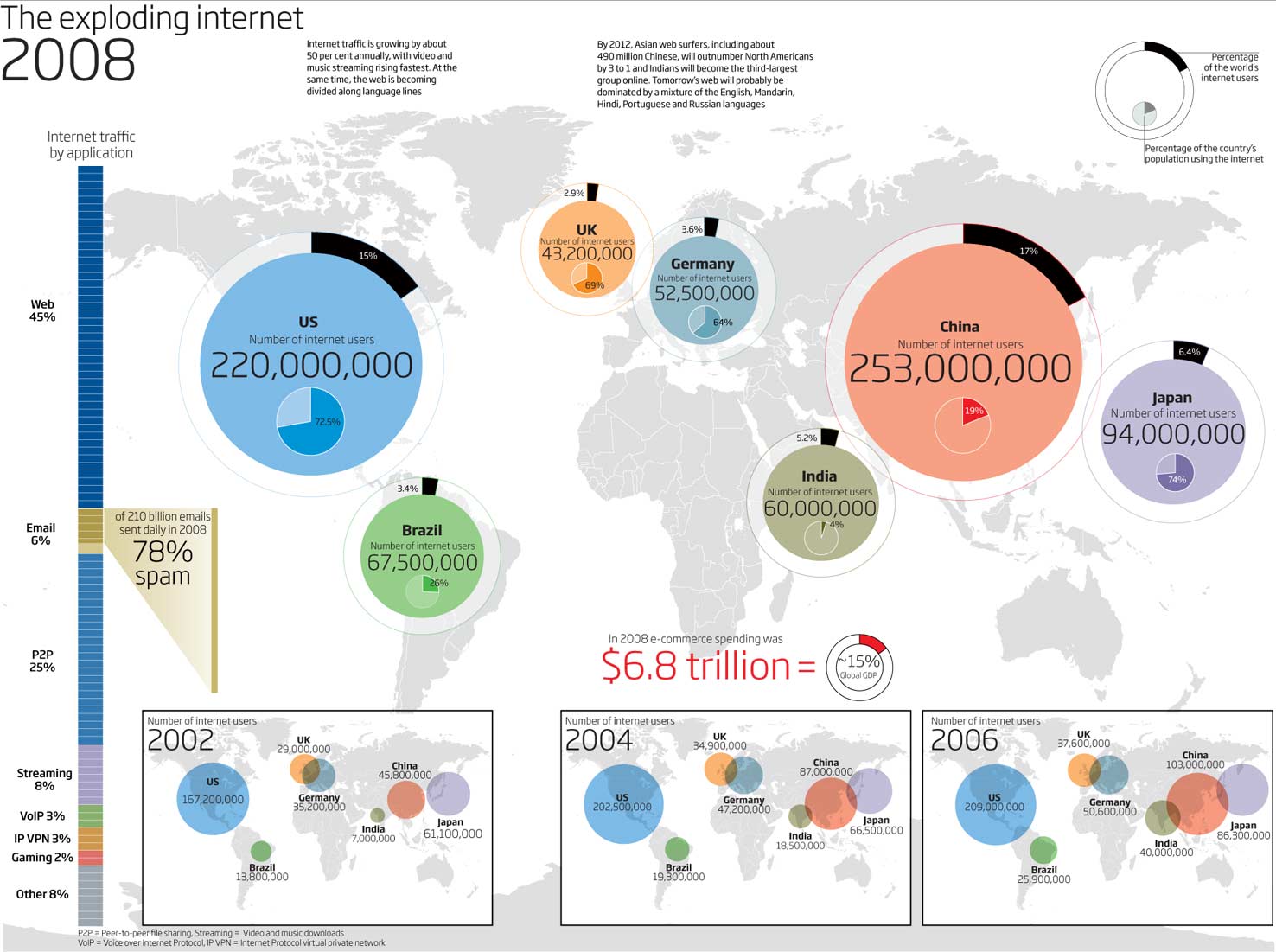
Despite these issues, China has still emerged as a major global component in e-commerce. This represents a specific use in technology, in this case the Internet, where social inequalities may have a significant impact on the dissemination of that technology. China has an enormous number of online shoppers at twice as many as those in the U.S.; however, one would expect this number to be higher since China's population is 4x that of the U.S.

Tuesday, November 29, 2011

Do IP rights really work?

Modern arguments surrounding intellectual property (IP) rights range from keeping the way it is to reforming it to possibly banishing it all together. The question typically about what IP rights really do, how they affect innovation, and whether or not they are necessary.

The intention of IP rights is to provide incentive for proprietors by protecting them against "free riders" and unfair forces and providing a limited monopoly over inventions. The problem is that this assumes an extremely market-driven arena where these protections are vital for productivity and the protection of enterprises. Looking back on the history of invention, we actually see that a lot of invention comes out of non-market, individual entities rather than market-driven corporate entities. Beyond the invention of the printing press, information exchange and commerce became more interconnected, intention shifted towards networked entities while remaining non-market oriented, such as with open source communities and academia. The printing press and information technologies are not only game changers in the world of social worlds but are also causing paradigm shifts in invention itself. This shift, along with the ridiculously high litigation costs of defending patents, has rendered IP rights ineffective for small entrepreneurs and inventors.

In cases where patents are potentially useful, their abuse has become far too easy. The most public form of this abuse as of late is the patent war between different companies in regards to smart phones, tablets, and mobile operating systems. The mechanisms intended to allow innovation have instead become a means for attacking other competitors in the market place, regardless of their legitimacy, in order to maintain monopolies over product lines rather than technological innovations. Patent trolls are a less publicized problem that are on the rise. A patent troll is " a person or company who is a non-practicing inventor, and buys and enforces patents against one or more alleged infringers in a manner considered by the target or observers as unduly aggressive or opportunistic, often with no intention to further develop, manufacture or market the patented invention." They do not contribute to innovation in any way, but rather they exploit the system solely to make money while preventing innovation. These problems and more are some of the reasons why companies tend to keep industrial secrets. They're also why the open source community has taken off so much, bypassing much of the traditional IP system and the problems associated with it.

We recently passed the American Invents Act to reform our patent system, but unfortunately, as is often the story with government reform today, the changes are mostly superficial and don't really address the deep conflicts in the patent system. Two amendments in the bill tweak the patent filing deadline and grant the USPTO rights to the fees it collects. Earlier versions of the bill changed how infringement damage is calculated, potentially curbing patent trolling, but this part did not make it to the American Invents Act. Really the only major changes presented by this bill are a change from "first to invent" to "first to file," which is how a lot of the world already operates, and creates a "post-grant review" process to challenge bad patents. These may be good changes but are ignoring some of the biggest problems that face small developers.

With the number of software patents on the rise and with more small developers and more large companies developing technologies at a faster rate, the patent system is having difficulty adapting. It worked for a period of time, but was quickly obsolete and it has not been seriously reformed in quite some time beyond minute changes to make it appear that we're reforming it. The answer is not to abolish IP rights, but to adapt our system to what we really need today. The answer doesn't have to be extreme. It just has to be reasonable.

Tuesday, November 1, 2011

Design and Innovation

Companies like to call their products innovative, because we like to buy innovative things. Who doesn't want the next big innovative gadget? We have, however, come to forget what innovation really is, and we often confuse design with innovation. Good aesthetics, solid construction quality, ease of use -- these are all characteristics of good design, but not necessarily of innovation.

Looking at SCAMPER, innovation is really about making a change in the core functionality of an idea or object or changing the way in which we see and use it for the better. One of the questions we can ask about innovation is "design for what?" which is now becoming "design with what?" Those two versions of the question can blend together when we see that so many of the so-called famous inventions are really those seemingly-small things that change the way in which we innovate. Adhesives, glass, GPS, wrenches, and so forth; these aren't just inventions that make some task in our lives easier. They are tools and enabling technologies which not only have a broad and deep impact on our lives but also change the way in which we can innovate and create even more new technologies. At one point, they were the product of "designing for what," and now they are part of "design with what."

There are a slew of arguments and writings about the innovative culture in the United States, but I argue that part of why we are so innovative is that, in the past, we valued those seemingly-small enabling innovative inventions. Companies would expend resources on R&D in the hopes of benefiting themselves and also the market, realizing that creativity and innovation can pay off in the long run. Some companies are abandoning R&D in hopes of immediate return on brute force research and design, and companies like Hewlett Packard are discovering the hard way that such decisions are economic suicide. In the short run it may work, but a company that cannot innovate and cannot stay ahead of the curve will not survive. This reflects our modern culture that is based around immediate gratification rather than investing in the future and working hard for a payoff.

Tuesday, October 25, 2011

Why Outsource?

You can't listen to a political debate anymore without hearing about outsourcing, and rightly so. Job outsourcing is a major topic in today's politics because it affects us both individually and as a a nation. It seems that there are two sides pitted against one another -- the companies who outsource their work and fight for policies to make it easier to do so, and workers who fight against outsourcing.

So why do we outsource? We are in a global economy where we cannot isolate ourselves from the rest of the world. To stay competitive in the global markets, and even at home, outsourcing is a part of cost-effective product development and manufacturing. The issue and cause for debate is that outsourcing has become less of a method of increasing productivity and more of a method for maximizing profits at the expense of workers here at home. Outsourcing isn't practiced for the good of the workers; it's practiced for the good of the companies in order to maximize their profit margins, and it transfers economic wealth to other nations. Some motives may be articulated so that they seem to be beneficial to consumers, but by and large they are corporate-driven.

Some argue that outsourcing allows for inexpensive goods in higher volume, making our lives easier because we can save money at the cash register. I argue against this assertion, seeing the economic system as a carefully balanced ecosystem. Resources flow back and forth between consumer and producer. Consumers give money to producers in trade for goods, then producers pay that money back to consumers for their labor in producing more goods. When labor is outsourced, the money that would normally be fed back to the consumer instead leaves the system, restricting the purchasing power of the consumer. So, yes, products may be cheaper, but the consumer also has less money to spend.

Because the direction of our economy is driven by the motives of producers rather than by the motives of consumers, there has been a devaluing of skilled labor in many sectors. This is most notable when looking at immigration labor. We outsource much of our labor, we make it difficult for highly educated persons to immigrate to our country, and then we exploit the cheap labor of illegal and/or unskilled immigrants. Meanwhile, it is becoming more and more difficult for educated college students to find jobs. Perhaps this trend in our economy is part of the fuel for the Occupy Wall Street movement.

Instead of exploiting the global market for driving higher profit margins at the cost of skilled laborers, we should use the global market to increase productivity globally and also locally while reaping the rewards without having to make detrimental sacrifices. Concepts such as global teaming and taking advantage of the 24-hour clock, or sharing resources across multiple locations could yield enormous gains for companies while also maintaining a solid workforce both at home and abroad. Such a shift isn't impossible, and for some competitive and on-the-edge companies may already be occurring. It will, however, require changes in our relationships with other nations and in our rather stingy intellectual property system.

Tuesday, October 18, 2011

Engineering Challenges

Great engineering comes out of great challenges. Difficult, interesting problems are what drive us to creative solutions and innovation that change our world beyond the scope of just a single instance. From commercial flight to personal computers, the last few decades have produced so many engineering achievements that we now rely upon.

One of the most important challenges right now, voted highest by visitors to Grand Challenges for Engineering, is the development of solar energy into a economical source of power. Solar energy is such an important resource because it is a freely available clean resource that could easily meet the demands of Earth's entire population. This is surprisingly lower than other resources, like offshore wind turbines. It can also continue to meet our demands far into the future for any conceivable demands, and unlike the fossil fuels and nuclear fuels we use now, it does not produce any pollutants. To further the viability of solar energy, the technology needs further development to increase cell efficiencies and reduce costs.

Viability does not stem only from the solar cells themselves, but also from surrounding technologies that support and enable the resource extraction and usage. For one, "current solar cell designs require high-purity, and therefore expensive, materials..." However, developments in nanotechnology may make that problem obsolete, allowing cells to be produced with more inexpensive materials. Also, energy storage is an expensive support infrastructure, especially when implementing at-home solar energy. Several technological and infrastructure changes may help this issue, such as better batteries, mechanical energy storage, or smart power grids that can accept excess power during the day and supply power at night.

The reason for the lack of solar energy implementation in the United States is not due to a lack of feasibility, but rather a lack of direction and push for its widespread use. Several other countries have substantial solar energy infrastructures, and Germany produces 6,000% more solar energy than the U.S. despite the U.S. having 4,000% more available sun light. The amount of money spent in the U.S. on solar energy subsidies is miniscule compared to those on fossil fuels, hindering its growth.

Fun infographic on the growth of solar energy vs growth of facebook.

Tuesday, October 11, 2011

Gambling with Nature

Natural disasters are a fickle opponent because there is no completely predictable process or enemy to counter. Instead, we rely upon historical information, intuition, and a sense of risk. Before we can even address good or bad design issues, we can look at how we even choose what level of disaster to design for. A great example is the recent catastrophe in Japan when a large earthquake wrecked some regions, but perhaps the greatest damage came from the resultant tsunami spilling over the sea walls and causing the nuclear reactors to dump radiation onto the surrounding civilians.

Why weren't the sea walls designed to withstand such a tsunami? The answer is in cost/benefit and risk analysis during the designing of the sea wall. Sure, engineers could have designed an impressively robust sea wall that could withstand the entire ocean hurling at it, but such an undertaking would be costly. Engineers must balance the cost of the measure with the benefit of it succeeding. If a disaster causes $5 billion in damage, and there's a 1/1000 change of the disaster occurring, then it makes sense to spend about ($5B/1000) or $5 million dollars to assure that event is mitigated. This damage prediction also includes the loss of life -- and yes, you can place a dollar value on a life; after all, that's what insurance companies do. There is also the matter of risk. Looking at historical data, engineers can extrapolate the likelihood of certain size events. Using that probability curve, they choose an event size to design for. Of course, a larger event may happen that has never occurred previously, and that is a risk that comes with gambling with nature.

A popular area of engineering R&D is in earthquake proof buildings. There are many systems out there, such as the one currently being developed at Stanford to absorb the energy of a building's motion during quakes. Unfortunately, like many other systems, it is not in wide spread use because of the relative youth of these designs, and thus not many buildings are equipped to handle earthquakes. The systems are more common, and necessary, in new skyscrapers where the building can sway even during normal days yet alone during an earthquake. For example, Taipei 101 contains a tuned mass damper to stabilize oscillatory motion in the structure. These sorts of designs and technologies are mitigation techniques being employed prior to the natural disaster to minimize the effects of such disasters.

Some of the worst aspects to natural disaster design is not in a physical design, such as a structure or device, but in the policy and response. We may not think about policy and social regimes as associated with design, but they really are -- there is a lot of engineering and creative thinking involved. These responses also employ technological devices and scientific knowledge which may directly affect the policies or which may aid in executing the response. The key is to find a synergy between engineering and policy. Of course, the solution to this problem can come on several fronts. First, engineering could help to shape the policy response directly, though this is often problematic because of the disconnect between engineers and politicians. Second, engineering solutions can aid in the response through technological means. Emergency communications, rescue vehicles, and other routes can all provide post-disaster relief.

Countering natural disasters entails both a pre-disaster effort to mitigate problems and also a post-disaster effort to recover from problems that were not mitigated. Unfortunately, the later is largely driven by government response which may or may not be dependable in any given situation, but engineering design solutions can certainly aid in the response. As for mitigation, engineering can play a much more active role in strengthening our world against natural threats.

Tuesday, October 4, 2011

We All Depend on Water

Water is one of the basic necessities for life for almost all living creatures. For humans and many aquatic species, fresh water is specifically required, but that precious resource is degrading in many parts of the world. The result is trying for both aquatic life and civilization in some parts of the world. We need to take a critical look at this problem, however, because jumping on the bandwagon at home may not always be the right solution.

The problem is hitting the hardest in northern Africa and some parts of Asia where both access to safe water and fish diversity suffer. There are a multitude of organizations whose purpose is to bring safe water to some of these regions, and the Clinton Global Initiative and WASH Advocacy Initiative, backed by companies such as Proctor & Gamble, have recently committed to bring water to 2 million people in Africa. Stories like this are common, which may be due to the public outcries for assistance and the transparency of these issues and the number of people involved. Simply providing ways to clean water, however, may not be enough. The availability of fresh water in these regions is indeed low, but that availability is only part of the issue, and solar stills and desalination cannot solve the entire demand. The other factor is that water is heavily used in agriculture, and very little or virtually none is left or used for domestic needs. The situation in those regions -- limited water resources and a highly agricultural economy -- is inherently problematic. It is even more so problematic when you look at booming population densities and also pollution generated by unsustainable agricultural practices.

We like to think we are resource conscious here in the United States, often so we can feel good about ourselves for "saving the environment" or so that we can save a few dollars on our utility bills. Aside from droughts in some parts of the southwest, the U.S. is pretty good on water supplies, so putting a low-flow flush valve on your toilet won't likely make a big difference in saving lives. I am by no means arguing that being resource-conscious isn't a bad thing. Saving a little bit of water here and there saves money, saves energy, and can help the environment. All-in-all though, we are pretty efficient at drawing water and cleaning our sewage. The places that really need help are those that are developing and who are stuck using unsustainable practices to maintain their populace.

Innovations like the aquacone and desalination techniques can certainly have a major impact on regions where safe water is scarce, but if we are to address the problem of water supplies on a global scale, we need to step back and look at the big picture. This isn't something that we can just engineer our way out of with a clever piece of plastic. It needs to be addressed at the level of the global societal system. As we become more aware of our environment and how we must sustain it so that it can sustain us, we must change the way we operate. This requires some pretty major innovation as a civilization.

Tuesday, September 27, 2011

Just Another Guy in the Room

For a long while, and even to a certain extent now, the United States is a world leader and has certain self-proclaimed authority to assert itself. We were the one in charge, but that power is shifting -- or rather, it's being spread out among other countries. We are becoming just another guy in the room of nations; granted, we are still one of the tough guys, but there are others, too.

It's difficult to think of any areas in which we are bringing up the rear, and it's also difficult to think of any modern areas in which we are in the forefront. One of the biggest factors in development -- education -- though, shows us that we are not doing as well as we may think. 2009 data shows that the U.S. is somewhere in the middle of the top 34 countries, ranking significantly lower in math than in science or reading. Over the last several years, we have been either steady or slowly dropping in scores while other countries, including those who are low in the ranks, are improving. We are indeed highly ranked on the education index, but this only accounts for literacy rates and education enrollment rates.

What about happiness? We are all people with a finite time on this planet, so naturally we want to be happy in life. If a country is doing well in the global market, it doesn't really matter if its citizens are miserable. Similarly, it shouldn't be as big of a problem if we're "just another guy in the room" so long as we are very happy. Of course, "happiness" is a difficult thing to measure on a national scale, though some organizations are attempting to establish such studies. Similarly, the Happy Planet Index measures the "ecological efficiency of supporting well-being" within countries. Here, the U.S. ranks incredibly low at number 150 in the year 2006, though we rose to 114 in 2009. It may seem surprising that certain countries, like Cuba, rank highly in this index, but the HPI does not look at political and economical factors that often make countries undesirable in our view. "The HPI is based on general utilitarian principles — that most people want to live long and fulfilling lives, and the country which is doing the best is the one that allows its citizens to do so, whilst avoiding infringing on the opportunity of future people and people in other countries to do the same."

It should be obvious that no single index is perfect and that no measure can capture every aspect of the very complex and dynamic machines that are countries. It should also be obvious that the United States is not an unchallenged leader in the global arena, and that we should pay careful attention to our nation and the nations around us.

Tuesday, September 20, 2011

Great Achievements

We like to think of the United States as a glorious proving ground for innovation and engineering achievements, and indeed it often does produce some fantastic results. It's also a misconception to think that we are the kings of advancement and that we are the foremost global leader in everything. In fact, we are falling behind in many areas -- even in areas where we planted the seed.

For one, let us look at the internet, which started with ARPANET in the United States. In 2007, we were far behind in survey of national internet speeds, and in 2010 we still were not even in the top 10. We may see improvements over time, but year after year we fall behind other countries. While we may have more people on the net than any other country, many advocates blame a lack of competition for our failing development. We have a near purely corporate-driven ISP system, but the marketplace thrives on regional monopoly rather than competitiveness, offering little or no incentive for service improvement. In the meantime, other countries plow ahead in the global marketplace.

Looking at the other end of the spectrum, small engineering feats emerge out of necessity -- at least, they are small in terms of scale and complexity, but they can be immense in terms of impact. A great example is the WaterCone (this one is slightly different than the AquaCone listed on the assignment page). It's a hard plastic cone that's designed to rest over a tray of water, collecting distilled vapors and condensing water into a ring around the base. The unit is user-friendly such that, to remove the water, one simply unscrews a cap on top and pours the water into a container. Such a simple yet effective technology has come out of the rising realization of a need for clean water in under-developed countries. The device can be created for about $30 and lasts about 5 years, and even that could be improved with further manufacturing and mass production techniques, making this an effective solution for providing clean water. Examples like these remind us that engineering is not just about creating immensely complex systems for a technological world. Engineering is also about finding simple solutions for huge problems in a highly unequal and challenging world.

Monday, September 12, 2011

A Habit That's Hard to Break

We live in an era of material wealth where our value is based upon our ability to earn money and then spend that money on "stuff," as is described to some shocking level in Annie Leonard's film Story of Stuff, Full Version; How Things Work, About Stuff . We've become so involved in this life style where we focus on acquiring, using, and discarding goods as quickly as possible and on always having the newest model of whatever it is we have. What we typically don't realize is that a cell phone, battery, napkin, or any other object involves much more than just buying it, using it, and discarding it. In fact, there is an entire product life cycle from extraction of the materials, to manufacturing, distribution and sales, use, and waste. The support of this cycle requires immense energy and physical resources -- even something as simple as a cup of coffee requires substantial effort from multiple countries and resource centers.

The resources that go into this cycle, and the process of moving those resources from extraction to refinement to use in the product, is the supply chain. To support our growing demand for "stuff," we need huge supply chains on a global scale. In fact, we've become so dependent on these global supply chains that disruptions in single links can cause major problems. Now, our dependence on these supply chains is neither an inherently good nor bad thing. It's a habit we have gotten ourselves into, but not all habits are good. Brushing your teeth daily and smoking are both habits, but clearly not of the same ends. Global supply chains carry issues such as volatility and exploitation, but it also provides deep reserves of resources to match demand and a wide selection for manufacturers so that they may choose the highest quality and cost effective materials.

What we need to realize is that we cannot simply disconnect from these global supply chains even if we wanted to. We are tied to them for the time being. We have become so tightly connected to the global supply chain because our enormous demands for consumption require enormous supplies of materials, and it's easier and easier for us to buy more and more inexpensive, disposable items because the global supply chain enables low-cost and effective resources. It has become a self-feeding cycle from which it may be extremely difficult to remove ourselves. Any change on a global scale will be slow.

How we continue forward with the global supply chain model does not necessarily require a given direction in how we continue to use resources. It is possible for us to push forward with efforts in recycling and renewable resources while also continuing to expand the global market. Different countries may specialize in different parts of product life cycles or in different resources, which can be beneficial for the global market. We must look at this system as a whole and realize that the flash drive sitting on our desk took quite a journey from many far away lands in order to end up sitting in front of you.

Tuesday, September 6, 2011

The War Against Social Media

Social media has no doubt become a powerful tool in recent years, and it reflects the modern paradigm shift from a market of tangible goods to a market of information. We are becoming increasingly linked, and it seems that, for many people in developed countries, the only way to achieve the peace that comes with isolation is to travel far from civilization -- I can attest to this from my trip to Big Basin state park last Summer.

Social media, much like the printed book or even a gun, by itself represents an idea. A printed book represents a freedom of information and access to that information; a gun represents the power and authority placed into the hands of an individual or government; social media represents the flow of ideas and a shared, collective intelligence among society. However, it's only a matter of time before books become an enabling tool for education and propaganda, guns become a tool for hunting and genocide, and social media becomes a tool for revolution and prosecution.

The internet, another enabling technology, has seen a deluge of news articles and blogs on cyber-sharing's role in dissent in Egypt and Tunisia, and it's been sparking rebellion and revolution in countless other countries in a cascade of power shifting. This part of the story has been covered over and over, leaving few rocks unturned. I would like to explore another face of the story: the story of the political response to this new interconnectedness and freedom of sharing among those people who, previously, were under the tight control of their government. It used to be the case that rulers could trickle information to their people, shaping views and restraining dissent; but, in the same way that the printing press freed our dependence upon holy men to read Latin scripts to their congregation, social media has allowed the sharing of ideas -- including ideas of change.

Many political responses have been as expected, such as Egypt's attempt at severing the internet to cut off the flow of dissent, reveiling that the Middle East is vulnerable to such cyber tactics. Some responses, however, have been a tad shocking, if not also concerning. Water and squirt gun fights, organized over Facebook as mere fun demonstrations, have been interpreted has threats and squashed by police forces in Iran, and even the UK has jumped the gun and made arrests for such non-violent events organized over social media outlets.

Some responses have been much more extreme, illustrating that governments and organizations are seeing social media as a serious threat to their status quo ante. Britain's Prime Minister has even gone so far as to consider restrictions on social media. Incidents have even occurred here in the U.S. Recently, protests planned at BART stations in San Francisco sparked BART to shutdown cell phone networks in an effort to hamper the events. The highly controversial decision ignited fierce debate and even called in the FCC to be involved.

Social media has not just been an enabling technology for change and revolution through the free flow of information. It has also been a powerful force in the political world, and it is not one which we can ignore.